
Most people searching for cystic acne vs. hormonal acne treatment assume they’re choosing between two separate conditions. Cystic and hormonal actually describe two different things about a breakout: cystic acne describes how severe and deep the lesion is, while hormonal acne describes what’s driving it. A single breakout can be both at once, which is why the two terms get confused so often.
Sorting out which question you’re actually asking- how severe is this, or what’s causing it- changes what treatment path makes sense. This post walks through what each term actually means, how a provider tells them apart, and how treatment differs depending on which factor is doing the most work.
The Difference Between Cystic and Hormonal Acne
It helps to think of “cystic” and “hormonal” as answers to two different questions rather than as competing labels.
Cystic acne is a description of lesion type: large, deep, inflamed nodules or cysts that form beneath the skin’s surface rather than surfacing as a typical whitehead or blackhead.
Hormonal acne is a description of a trigger pattern: breakouts driven by fluctuating androgens, a class of hormones that increase oil production, or by cortisol, the body’s primary stress hormone.
Because these labels describe different things, they overlap constantly. Hormonal acne frequently shows up as cystic lesions, particularly along the jawline and chin, because androgen-driven oil production combined with clogged pores tends to produce deeper, more inflamed breakouts in that area.
A patient can have hormonal cystic acne. That overlap is the norm most consumer content skips past.

Characteristics of Cystic Acne
Cystic acne, sometimes called nodulocystic acne, refers to breakouts that form deep in the skin rather than at the surface. These lesions are typically painful, slow to resolve, and carry a meaningfully higher risk of acne scarring than surface-level whiteheads or blackheads because the inflammation reaches deeper skin layers.
Cystic acne does not tell you why it’s happening on its own. Deep, inflamed lesions can result from hormonal fluctuations, bacterial and inflammatory activity in the pore, genetics, or some combination of the three.
Calling a breakout “cystic” describes its severity and depth. A provider still has to look past the lesion type to figure out what’s driving it.
Common Patterns and Causes of Hormonal Acne
Hormonal acne refers to breakouts tied to shifts in androgen levels or cortisol rather than a specific lesion type.
In women, this often traces back to the menstrual cycle, pregnancy, perimenopause, or polycystic ovary syndrome, also known as PCOS, a hormonal condition that can drive persistent, treatment-resistant breakouts alongside other symptoms. In both men and women, sustained stress and elevated cortisol can produce the same androgen-driven breakout pattern.
A few patterns give providers a practical way to recognize hormonal acne. It tends to cluster on the lower face, including the jawline, chin, and neck, rather than spreading across the forehead and cheeks. It often flares on a predictable cycle, worsening around the same time each month. It is also more common in adult women than in any other group.
These are tendencies clinicians look for, not fixed rules, and hormonal acne itself can range from a handful of mild breakouts to a fully cystic presentation. Readers who want a deeper look at how hormonal drivers show up specifically in adult acne, including why the Las Vegas climate compounds the problem, can review our guide to adult acne treatment.
How Providers Evaluate Cystic and Hormonal Acne
Distinguishing cystic from hormonal acne, and figuring out how much each factor is contributing, isn’t a single visual check. It comes from a combination of clinical examination, a history of when and where breakouts occur, and, in some cases, targeted lab testing.
A few signals typically prompt a provider to consider a hormonal workup: irregular menstrual cycles, excess facial or body hair, acanthosis nigricans, darkened, thickened patches of skin often found at the neck or underarms and associated with insulin resistance, or acne that appears suddenly and severely in an adult and doesn’t respond to standard treatment.
When those signals are present, testing generally looks at hormone levels such as testosterone and DHEAS to screen for an underlying condition like PCOS.
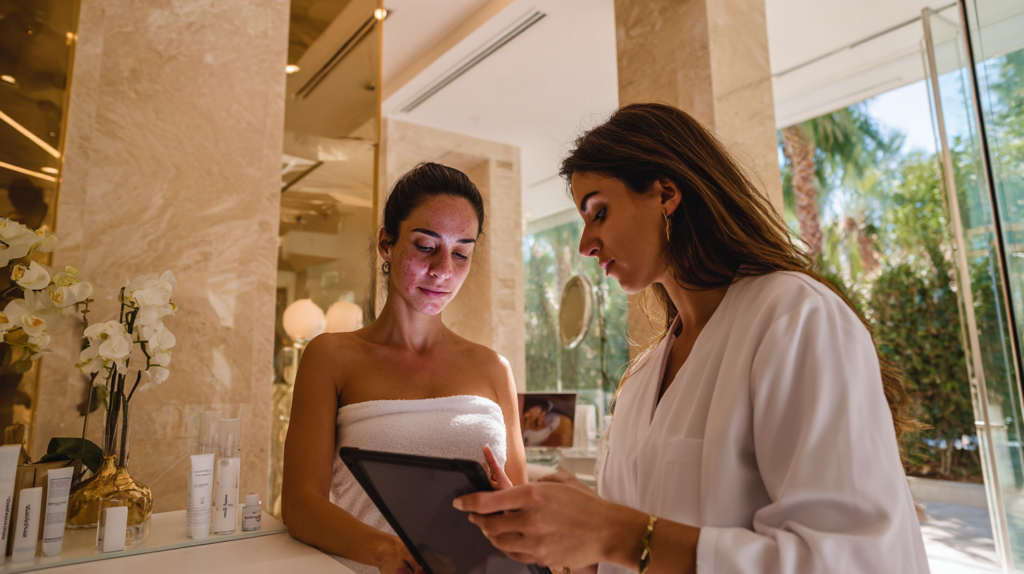
A provider makes this evaluation during a consultation, using pattern history and clinical exam findings together rather than relying on a single sign. A professional skin analysis gives a provider that pattern history and clinical picture, which then determines whether hormonal testing, dermatology referral, or in-office treatment is the right starting point.
Treatment Options for Severe or Cystic Acne
When the priority is controlling severe, deep, or scarring-prone lesions, treatment tends to focus on reducing inflammation and lesion depth directly.
Oral isotretinoin, a prescription retinoid, is the treatment most consistently associated with clearing severe, treatment-resistant nodulocystic acne, although it requires physician oversight and ongoing monitoring throughout the course of treatment.
Intralesional corticosteroid injections, delivered directly into an active cyst or nodule, can bring down inflammation and pain in a single lesion within days. Providers treat this as a temporary measure for individual breakouts rather than a long-term solution on its own.
Topical retinoids and benzoyl peroxide typically continue as maintenance therapy between and after flares, helping prevent new lesions from forming even once the acute cystic activity has calmed down.
All of these fall under prescription or provider-administered care rather than an over-the-counter routine, which is why board-certified oversight matters for anyone dealing with recurring cystic breakouts.
Treatment Options for Hormonal Acne
When androgen fluctuations or cortisol are the primary driver, treatment tends to target the hormonal pathway itself rather than only the visible lesion.
Spironolactone, a medication that blocks androgen activity, is commonly used as a first-line hormonal therapy for women with persistent acne. It is often used alongside a combined oral contraceptive, both to support efficacy and, since spironolactone requires avoiding pregnancy during use, for contraception.
Side effects can include changes in the menstrual cycle, breast tenderness, and increased urination. A prescribing provider weighs those effects against a patient’s full health history.
Combined oral contraceptives are also used independently for acne tied to hormonal cycles, and a prescribing provider chooses the specific formulation based on a patient’s health profile and other needs.
Topical retinoids and azelaic acid remain part of the picture because they address pore congestion and inflammation regardless of what’s triggering the breakout in the first place.
A physician or OB-GYN handles prescription hormonal therapy for acne. A medical spa does not diagnose or prescribe it directly.
Blue Point Medical Spa’s Role in an Acne Treatment Plan
A medical spa’s role in either scenario is specific: a thorough skin analysis to identify lesion pattern and likely drivers, in-office treatments that support inflammation control and skin recovery, and a referral to a dermatologist or OB-GYN when the picture points toward prescription hormonal therapy or isotretinoin.
Blue Point Medical Spa’s Acne Bootcamp program is built around that first piece: a structured combination of in-office treatments and a supervised at-home protocol designed to reduce active breakouts and support skin recovery, delivered by or under the supervision of board-certified providers.
This works alongside prescription hormonal treatment rather than instead of it. A patient managing hormonal acne with spironolactone, for example, can still benefit from in-office support that addresses inflammation and skin barrier health while the prescription treatment takes effect.
Readers curious about the broader menu of in-office options for acne-prone skin can review our guide to medical spa treatments for acne.
Individual results vary based on lesion type, hormonal factors, skin condition, and how consistently a treatment plan is followed. No treatment, whether in-office or prescription, works on a fixed timeline, and a provider can speak to realistic expectations only after a full evaluation.

FAQ
Can hormonal acne also be cystic?
Yes, hormonal and cystic describe different aspects of acne. Hormonal describes the underlying trigger, while cystic describes the depth and severity of the lesion. Hormonal fluctuations can lead to deep, painful cysts, particularly around the jawline, chin, and neck.
Does cystic acne always require prescription treatment?
Not every deep breakout requires the same treatment, but recurring, painful, or scarring-prone cystic acne often benefits from prescription or provider-administered care. A licensed provider can determine whether topical treatments, oral medication, injections, or a combination of approaches is appropriate.
When should hormonal testing be considered for acne?
A provider may consider hormonal testing when acne appears alongside irregular menstrual cycles, excess facial or body hair, acanthosis nigricans, sudden severe adult breakouts, or poor response to standard acne treatment. Testing may include hormone levels such as testosterone and DHEAS to evaluate for conditions like PCOS.
Conclusion
Guessing whether a breakout is cystic, hormonal, or both, and then choosing products based on that guess, is one of the more common ways acne treatment stalls. A product designed to address surface congestion may not be enough for deep inflammatory lesions, while an in-office treatment cannot correct an untreated hormonal condition on its own.
The more useful starting point is a consultation that looks at lesion type, breakout location, timing, medical history, lifestyle factors, and previous treatment response together. That evaluation helps ensure the treatment plan matches what’s driving the breakout rather than addressing only its visible appearance.
Depending on the findings, the appropriate plan may include professional skincare, in-office acne treatments, a supervised at-home protocol, prescription therapy from a physician, hormonal evaluation, or a combination of these approaches.
Schedule a consultation with Blue Point Medical Spa to get a clear read on what’s behind your breakouts and determine which treatment path, in-office prescription, or a combination of both- fits your skin.
Individual results vary. This information is educational and does not replace a personalized evaluation from a licensed provider.