
Pool season skin protection in Las Vegas has to account for conditions most sun-protection advice ignores: a UV index that reaches extreme levels for most of the summer, chlorine exposure that builds across a season of regular swimming, and reflected sunlight bouncing off water and pool decks that reaches skin even in the shade. Generic guidance covers the basics. It rarely addresses what happens to skin during a Las Vegas summer spent at the pool.
This guide walks through the local UV data, what chlorine does at the skin-barrier level, and a sunscreen routine built for real pool days rather than a beach day in a milder climate. For broader desert-climate habits and general warm-weather sun care, Blue Point’s guides on desert climate skincare and summer sun protection cover the year-round basics this post builds on.
Las Vegas UV Exposure During Pool Season
Las Vegas averages a UV index of 8.7 across roughly 294 sunny days a year, one of the highest annual averages of any U.S. metro area. During peak pool season, from May through September, daily UV index readings commonly reach 9 to 11 or higher, which the EPA classifies as very high to extreme.
At a UV index of 11 or higher, unprotected skin can burn within minutes rather than the hour or more it might take in a lower-UV climate. The desert location, high elevation, and clear skies most of the year all contribute to this intensity, and none of those conditions change because someone is standing in a pool instead of on a hiking trail.
The detail most people miss is timing. UV radiation is typically strongest between 10 a.m. and 2 p.m., which happens to overlap with the hours most families and visitors spend at the pool. A cloudy-looking sky does not reduce UV exposure at these levels, and neither does being in the water.
Reflected UV Exposure Near Pools and Water
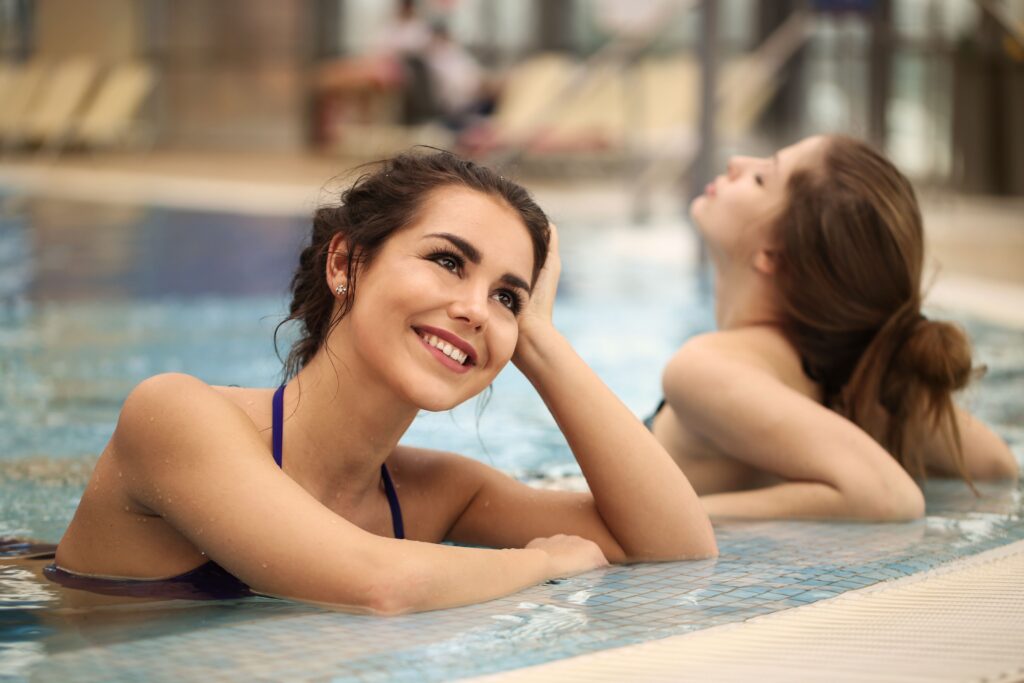
Direct overhead sun is only part of the exposure at a pool. Dermatology sources put water’s reflected UV at an estimated 10 to 25% of UV rays, and light-colored surfaces like sand or a bright pool deck can reflect a comparable or higher share depending on conditions. That reflected radiation reaches the skin from below and from the sides, not from above alone.
Sitting under an umbrella at a pool does not solve the exposure problem on its own. The umbrella blocks direct overhead sun, but it does little against UV bouncing off the water’s surface or a light-colored deck a few feet away. Reflective exposure comes from multiple directions and adds up across a day, which makes it easy to underestimate.
Shade still cuts total exposure and is worth using. It is not a full substitute for sunscreen during a pool day, especially in a climate where ambient UV is already high before any reflection gets added in.
How Chlorine Affects the Skin Barrier
Pool operators treat water with chlorine to control bacteria and other organic matter. Chlorine works through oxidation, a chemical reaction that breaks down organic material on contact. The problem is that chlorine does not distinguish between the organic matter it targets and the natural oils and surface proteins that make up a healthy skin barrier.
Repeated chlorine exposure strips away sebum, the skin’s natural protective oil, along with some of the proteins that help skin retain moisture. The immediate effects show up as dryness, tightness, and sometimes redness or mild irritation after a swim. A single pool visit will not cause lasting damage for most people, but Las Vegas pool season often means multiple visits per week for months at a stretch.
Repetition, not a single swim, drives the cumulative effect. Regular, unaddressed chlorine exposure across a season can weaken the skin barrier’s ability to hold onto moisture, which contributes to chronic dryness and can aggravate existing conditions like eczema or dermatitis. Patients who already manage sensitive or reactive skin tend to notice this pattern first, since their skin barrier has less margin to begin with.
Sunscreen Protection for Las Vegas Pool Days
Choosing Water-Resistant Sunscreen
No sunscreen is waterproof or sweatproof. The FDA only permits a “water-resistant SPF” label, rated for either 40 or 80 minutes of effectiveness while submerged or sweating, and that distinction matters more at a pool than almost anywhere else. During peak UV season, a broad-spectrum SPF 50 or higher gives more margin than a lower-SPF product, especially for anyone who swims for extended stretches instead of reapplying on a strict schedule.
Sunscreen Reapplication During Swimming
Even an 80-minute water-resistant sunscreen needs reapplication after that window and immediately after towel-drying, which strips the product faster than air-drying does. The general rule from dermatology sources is to reapply at least every two hours regardless of the water-resistance rating, and sooner after any swim. For a full pool day, that usually means reapplying more often than the two-hour mark suggests, since most people get in and out of the water multiple times per visit.
A few practical habits make this easier to sustain. Apply sunscreen 15 to 30 minutes before getting in the water so it has time to bind to skin, and reapply it after every swim rather than waiting only for a timer to go off. Use a lip balm with SPF, since lips burn easily and are frequently missed. During the highest-UV hours, pair sunscreen with a wide-brimmed hat and UPF clothing, since no sunscreen alone fully offsets extreme UV index readings.

Skin Recovery After a Day at the Pool
The window right after leaving the pool is a good opportunity to counteract some of the day’s exposure. Rinse off chlorinated water as soon as you can, rather than letting it dry on skin; this limits how long the chemical continues to interact with the skin’s surface. A fragrance-free moisturizer applied while skin is still damp helps trap moisture before it evaporates.
Hydration matters from the inside, too. Sun exposure and heat draw fluid to the skin’s surface and away from the rest of the body, so extra water intake on pool days supports recovery overall, not only how skin looks the next morning.
For patients who spend a large part of the summer at the pool, a professional skin analysis can help identify whether a season of sun and chlorine exposure shows up as ongoing dryness, uneven tone, or a change in skin texture that a home routine alone is not addressing. Blue Point Medical Spa also offers facials designed to support skin recovery between pool visits. These are options for patients who want additional support, not a requirement, and individual results vary based on skin type, sun exposure history, and how consistently a home routine is followed.
When Sun Exposure Requires Professional Care
Occasional mild redness after a pool day usually responds to the basics: getting out of direct sun, a cool shower, and a soothing, fragrance-free moisturizer. More significant sunburn is a different situation. According to the American Academy of Dermatology, sunburn that blisters, covers a large area of the body, or comes with fever or chills warrants a visit to a board-certified dermatologist rather than home treatment alone.
A board-certified provider matters beyond the acute sunburn, too. Cumulative sun exposure over a Las Vegas summer, layered on top of years of desert sun, is part of why some patients pursue sun damage repair treatments or a chemical peel later in the season to address tone and texture changes that build up over time rather than from a single day of overexposure.
A licensed provider evaluates skin condition and sun exposure history before recommending any of these options, since not every skin type or concern calls for the same approach. Individual results vary with any treatment discussion, and a consultation is the most reliable way to set realistic expectations for a specific case.
FAQ
How often should sunscreen be reapplied at the pool?
Water-resistant sunscreen should generally be reapplied at least every two hours and sooner after swimming or towel-drying. Even products labeled for 80 minutes of water resistance need to be reapplied once that period ends.
Does sitting under a pool umbrella provide enough sun protection?
An umbrella reduces direct overhead sunlight but does not block UV rays reflected from the water or the surrounding pool deck. Shade should be combined with sunscreen, protective clothing, and a hat during high-UV hours.
What should I do to dry skin after swimming?
Rinse off chlorinated water as soon as possible and apply a fragrance-free moisturizer while the skin is still damp. Drinking additional water can also support hydration after spending time in the heat and sun.
Conclusion
Las Vegas pool season combines three factors that most sun-protection advice treats separately: an extreme UV index, chlorine’s cumulative effect on the skin barrier, and reflected sunlight near water that adds exposure even in partial shade. None of these require avoiding the pool. They call for a sunscreen routine that accounts for swimming, a rinse-and-moisturize habit after getting out, and attention to how skin holds up across the full season, not only a single visit.
Individual results vary. A consultation with the team at Blue Point Medical Spa can help assess how a season of sun and pool exposure is affecting your skin and set realistic expectations for any additional support you might want.
Schedule a consultation with Blue Point Medical Spa to talk about pool-season skin care and what a personalized plan could look like for your skin.