Skin tightening gets used as a catch-all term for several different technologies, and that’s part of why so many people feel let down after choosing one. A treatment built for mild texture concerns won’t do much for visible jowling, and a treatment built for deeper tissue laxity is overkill for someone who just wants firmer-feeling skin. Understanding what each skin tightening approach actually does, and which degree of laxity it’s suited for, makes it much easier to have a realistic conversation with a provider in Las Vegas.
This guide walks through the two main non-surgical categories, radiofrequency (RF) and ultrasound, how each works at the tissue level, and how skin laxity severity affects which one, if either, makes sense for a given patient.
Skin tightening treatments and collagen remodeling
Skin laxity develops gradually as collagen, the structural protein that gives skin its firmness, and elastin, the protein that lets skin snap back into place, decline in both quantity and quality, a process that tends to accelerate somewhere around the mid-thirties to forties. Non-surgical skin tightening treatments don’t remove or cut skin. Instead, they use controlled heat to trigger the body’s own collagen-remodeling response, encouraging existing collagen fibers to contract and new collagen to form over time.
That single mechanism, heat-triggered collagen remodeling, underlies both RF and ultrasound devices. The two technologies differ in how they deliver the heat, how deep they reach, and which degree of laxity each is realistically built to address.
Radiofrequency skin tightening technology
Radiofrequency energy is a form of electromagnetic energy that converts into heat as it passes through the natural resistance of skin tissue. Unlike laser treatments, RF doesn’t depend on light absorption by pigment, so it can generally be used across a wide range of skin tones without the same pigment-related restrictions.
RF tightening works in two phases. The first is nearly immediate: when collagen is heated to roughly 65°C, existing collagen fibers contract, which is why some patients notice a subtle firming effect within days of a session. The second phase unfolds more slowly. The controlled heat creates a mild thermal effect that prompts the body’s fibroblasts, the cells responsible for producing collagen, to generate new collagen and remodel existing collagen over the following weeks and months.
RF devices used for skin tightening are typically FDA-cleared; most aesthetic devices are cleared rather than approved, and Blue Point Medical Spa uses that terminology accurately. Because RF energy generally penetrates to a moderate dermal depth, it tends to be best suited for mild to moderate laxity and for overall firming and texture improvement across broader areas, rather than for tissue that has visibly dropped or sagged.
Ultrasound skin tightening and Ultherapy
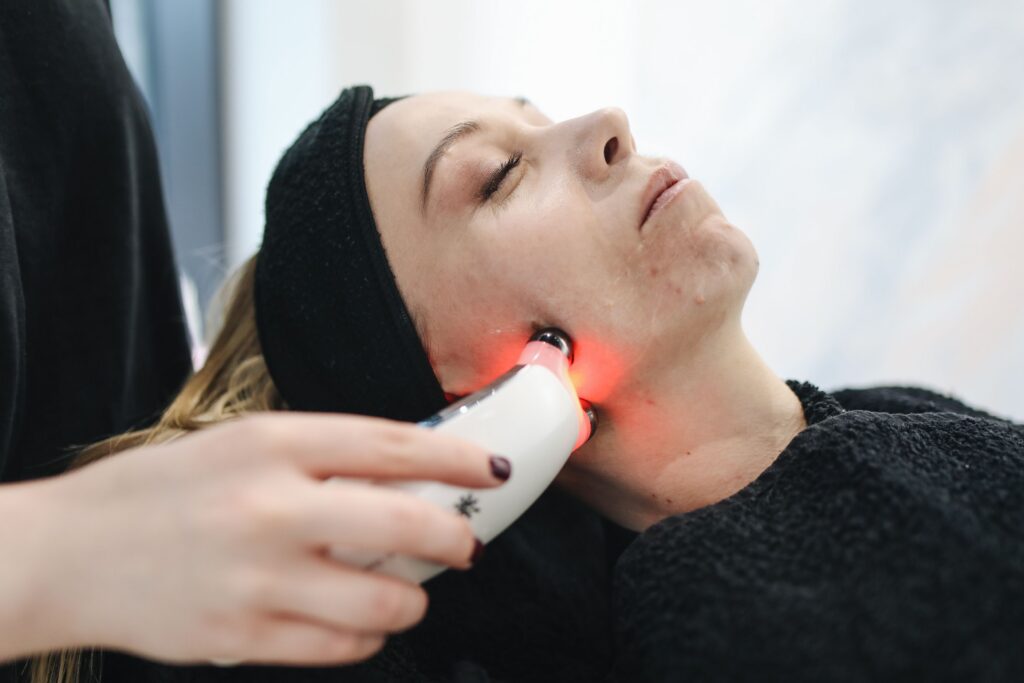
Ultrasound-based skin tightening uses focused sound wave energy rather than radiofrequency. The best-known device in this category is Ultherapy, which relies on a technology called microfocused ultrasound with visualization (MFU-V). The “with visualization” part matters clinically: it lets the provider see the tissue layer being treated in real time, rather than heating blindly.
MFU-V creates precise points of thermal effect, called thermal coagulation points, at specific depths chosen by the provider. Because ultrasound energy can be focused more precisely than RF, it can reach deeper structural layers, in some cases close to the same connective-tissue layer, the SMAS, that surgeons work with during a traditional facelift, without an incision. That thermal effect prompts the same underlying process as RF: fibroblast activity and gradual neocollagenesis, the formation of new collagen. Ultherapy is FDA-cleared specifically for non-invasive lifting of the brow, neck, and area under the chin, and for improving lines on the décolletage.
Manufacturer-cited clinical studies report measurable increases in new collagen following MFU-V treatment and describe results that many patients maintain for extended periods. Those figures come from clinical research and company-reported data, not a promise about what any individual patient will experience. Individual results vary, and a consultation is the only reliable way to set expectations for a specific case.
Because ultrasound reaches deeper structural tissue than RF typically does, it’s generally considered a stronger fit than RF for laxity that involves visible tissue descent, such as jowling, brow heaviness, or looseness along the jawline and neck. Readers who want a closer look at how Ultherapy sessions work in practice, including what a treatment actually feels like, can find more detail there.
Skin tightening treatments by degree of laxity
Neither RF nor ultrasound is universally “better.” The right fit depends heavily on how much laxity is present and where.
For mild laxity or prevention-focused goals, both RF and ultrasound can be reasonable options, though patients with only mild laxity to begin with may notice a more modest change, simply because there’s less to correct. This tier often overlaps with people who want to maintain skin quality rather than reverse a visible change.
For moderate laxity, where most non-surgical candidates fall, RF tends to be favored for broad-area firming and texture improvement, particularly when the concern is overall skin quality rather than a specific area that has dropped. Ultrasound tends to be favored when there’s visible tissue descent, since it reaches deeper structural planes that RF’s more superficial heating doesn’t typically address.
For significant or severe laxity, non-surgical treatments have a ceiling. For pronounced excess skin, dramatic sagging, or advanced jowling, a surgical consultation is generally the more reliable path, and neither RF nor ultrasound is positioned as a substitute for surgery at this level. Patients exploring where that line falls for their own skin may find it useful to review non-surgical facelift options as a broader category before deciding on a specific modality.
A licensed provider evaluates skin quality, the specific areas of concern, and a patient’s goals during a consultation before recommending RF, ultrasound, a combination, or a different approach entirely. That evaluation matters more than any general guideline, since laxity presents differently from one person to the next. Patients curious about the biology behind why laxity develops in the first place can review how collagen breaks down with age for more background on the underlying process that these treatments are designed to support.
Skin tightening safety and treatment candidacy
RF and ultrasound skin tightening are generally considered safe when performed by trained, licensed providers, but both have contraindications worth knowing before booking a consultation. These include open wounds, active lesions, or active cystic acne in the treatment area; implanted electronic devices, such as pacemakers or defibrillators, in the treatment field; and metal implants or other prostheses in the treatment area.
Patients should disclose these to their provider beforehand, since energy-based devices can heat metal. Pregnancy or breastfeeding is also a contraindication, since safety data hasn’t been established for either group, and most providers take the conservative approach of postponing treatment until afterward.
Temporary side effects are common and typically mild: redness that usually resolves within a few hours, some swelling that can last up to about 48 hours, and occasionally a brief tingling or numb sensation if a nerve is affected, which generally resolves within a few weeks on its own. Most patients return to normal activities the same day.
Session cadence differs by modality. RF tightening is often delivered as a series, with multiple sessions spaced over weeks. Ultrasound treatments are sometimes delivered in fewer sessions, occasionally just one, depending on the treatment plan a provider recommends. Either way, visible change tends to build gradually as collagen remodels rather than appearing all at once. Individual results vary, and no timeline or outcome can be guaranteed. A consultation with a board-certified provider is the most reliable way to set realistic expectations for your specific skin and goals.
Las Vegas climate and skin laxity
Sustained sun exposure and low humidity, both defining features of the Las Vegas climate, are widely recognized contributors to oxidative skin damage over time. That kind of cumulative damage can compound the natural decline in collagen and elastin, which is one reason skin laxity concerns can show up earlier or more visibly for people who spend a lot of time in this climate. None of this means treatment is urgent or that skin damage is somehow uniquely severe here. It simply means that daily sun protection is a genuinely useful habit alongside, not instead of, any professional treatment a patient chooses to pursue.
FAQ
What is the difference between RF and ultrasound skin tightening?
RF and ultrasound both use controlled heat to support collagen remodeling, but they deliver energy differently and reach different tissue depths. RF is generally used for broader firming and texture concerns, while focused ultrasound can reach deeper structural layers and may be considered for visible tissue descent.
How long does it take to see skin tightening results?
Some patients may notice subtle early firming, but visible changes generally develop gradually as collagen remodeling takes place over the following weeks and months. The timing depends on the treatment method, the area treated, the degree of laxity, and the individual response.
Can non-surgical skin tightening replace a facelift?
Non-surgical treatments have limitations and are not considered substitutes for surgery in cases of significant excess skin, advanced sagging, or severe jowling. A professional consultation can help determine whether a non-surgical treatment or a surgical evaluation is more appropriate.
Conclusion
RF and ultrasound skin tightening work through the same basic principle, heat-triggered collagen remodeling, but they reach different depths and suit different degrees of laxity. RF may be appropriate for broader firming and texture concerns, while focused ultrasound may be considered when deeper structural tissue and visible descent are involved. Neither option is universally better, and both have limits when laxity becomes more pronounced.
The most useful next step isn’t selecting a modality from an article. It involves having your skin quality, degree of laxity, treatment area, medical history, and goals evaluated so the recommendation reflects your individual needs and realistic expectations.
If you are considering RF or ultrasound skin tightening, schedule a consultation with Blue Point Medical Spa. A board-certified provider can assess your skin, explain the differences between available options, review safety and candidacy, and discuss whether a non-surgical treatment fits your goals.
Schedule a consultation with Blue Point Medical Spa to discuss the skin tightening approach that may be appropriate for you.