
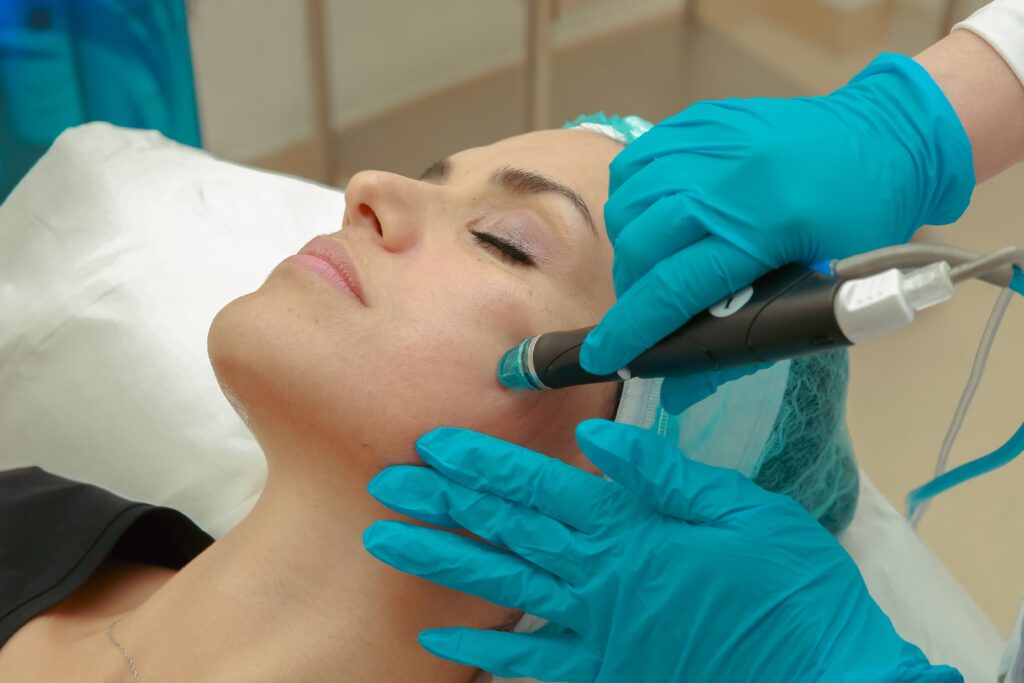
Microneedling is one of the most versatile treatments in medical aesthetics. The concept is simple: create controlled micro-injuries in the skin to encourage the body’s natural repair response. Over time, this process may support collagen production, improve the appearance of skin texture, and help the skin look firmer and more refined.
RF microneedling builds on that same foundation by adding radiofrequency energy. During treatment, the device delivers heat through the microneedles into deeper layers of the skin. This adds a thermal component that traditional microneedling does not include, which may create a stronger collagen remodeling response for selected patients.
Understanding the difference between RF microneedling and traditional microneedling can help patients choose the approach that better fits their concerns, downtime tolerance, skin condition, and goals. Neither option is automatically better for every person. The right choice depends on a professional skin analysis, medical history, and the type of improvement the patient wants to pursue.
Traditional Microneedling and Controlled Skin Renewal
Traditional microneedling uses a device with fine, sterile needles to create controlled microchannels in the skin. These channels usually reach depths between 0.5 and 2.5 millimeters, depending on the treatment area, skin thickness, and concern being addressed. The treatment does not remove skin. Instead, it creates a controlled injury pattern that activates the skin’s repair process.
The body responds through the wound-healing cascade. Platelets and other repair signals arrive at the treatment area, releasing growth factors that help recruit fibroblasts. These fibroblasts support the production of new collagen and elastin, which are structural proteins associated with firmness, resilience, and smoother-looking skin.
The microchannels may also improve the delivery of selected topical products used during or immediately after treatment. Ingredients such as hyaluronic acid, peptides, or growth factor-based serums may be applied when appropriate. This product-delivery benefit is one reason traditional microneedling is often used for patients focused on overall skin quality, texture, and mild visible aging.
Traditional microneedling may be considered for fine lines, mild acne scars, stretch marks, enlarged pores, dullness, and uneven skin texture. It may also be appropriate for a wide range of skin types, including many patients with darker skin tones, because it does not rely on targeting melanin with light-based energy. However, candidacy still depends on the patient’s current skin condition and medical history.

Radiofrequency Energy and Deeper Stimulation
RF microneedling uses the same needle-based concept as traditional microneedling, but it adds radiofrequency energy once the needles reach the target depth. The energy heats controlled zones within the dermis, creating an additional stimulus for tissue remodeling. This combination of mechanical and thermal stimulation may support deeper collagen remodeling than traditional microneedling alone.
The needles in many RF devices are designed to deliver heat below the surface while limiting unnecessary heating of the epidermis. This matters because the outer skin layer is more prone to visible irritation and pigmentation changes. By focusing energy into the dermis, RF microneedling may be considered for patients who need more structural support while still wanting a treatment that avoids fully ablative resurfacing.
The heat from radiofrequency energy may cause existing collagen fibers to contract and may encourage longer-term fibroblast activity. Over the weeks and months after treatment, the skin may gradually produce new collagen and elastin. This is why results from RF treatments are usually progressive rather than immediate.
Because RF microneedling is more intensive, it is not always the first choice for every patient. Someone focused on mild texture, early pores, or general glow may do well with traditional microneedling. Someone concerned about skin laxity, deeper scars, or more noticeable structural changes may be a better candidate for RF treatment after evaluation.
Treatment Depth and Skin Response
Treatment depth is one of the main differences between traditional microneedling and RF microneedling. Traditional microneedling creates mechanical micro-injuries at the selected needle depth. The repair response is concentrated where the needles reach, often in the epidermis and upper to mid-dermis.
This can be effective for surface-level and mid-level concerns, including fine lines, mild texture irregularities, pore appearance, and certain shallow scars. Because there is no added thermal energy, recovery may be somewhat lighter for many patients, although redness and sensitivity can still occur.
RF microneedling may reach deeper dermal layers depending on the device and settings. The RF energy creates heat zones at the needle tips, which may stimulate collagen remodeling in tissue layers that traditional microneedling may not affect as strongly at the same depth. This added depth can be useful when the concern involves skin tightening, deeper acne scarring, or crepey texture.
Deeper treatment does not automatically mean better treatment. The safest and most appropriate depth depends on skin thickness, treatment area, skin tone, sensitivity, and goals. A provider should adjust needle depth and energy settings carefully to reduce the risk of irritation, burns, or post-inflammatory hyperpigmentation.
Best Uses for Each Microneedling Approach
Traditional microneedling is often a strong option for patients seeking gradual improvement in fine lines, mild to moderate acne scars, enlarged pores, uneven skin texture, stretch marks, and general skin rejuvenation. It may also be a good entry point for patients who are new to medical spa treatments and want a collagen-supporting option with manageable recovery.
RF microneedling may be better suited for patients whose concerns include mild to moderate skin laxity, deeper acne scars, jawline softness, early jowling, crepey skin, or deeper wrinkles. The radiofrequency energy gives the treatment an added tightening and remodeling component that traditional microneedling does not provide in the same way.
Patient selection matters. Patients with active acne, open wounds, active infections, certain autoimmune conditions, uncontrolled medical concerns, or recent isotretinoin use may need to delay either treatment. A provider at a medical spa should review the patient’s health history, medications, skin condition, and recent procedures before recommending a treatment plan.
The provider may also consider whether the patient is prone to pigmentation changes. Although RF microneedling may be suitable for many skin tones when performed properly, settings must be adjusted carefully. Patients with a history of melasma, PIH, or reactive skin may need a more conservative plan.

Downtime and Recovery Differences
Both treatments involve recovery because both create controlled injury in the skin. The difference is that RF microneedling adds heat, which may make the visible recovery slightly more pronounced for some patients.
After traditional microneedling, patients may experience redness similar to a moderate sunburn. Mild swelling, tightness, and sensitivity may occur for 24 to 72 hours. Some patients return to routine activities quickly, but makeup, exfoliating products, retinoids, and direct sun exposure may need to be paused according to provider instructions.
After RF microneedling, redness and swelling may last a little longer. Some patients notice pinpoint marks, mild crusting, tenderness, or warmth for several days. Full visible recovery may take several days, depending on treatment intensity, skin type, and the area treated.
Both treatments require careful sun protection during the healing period. Patients in Las Vegas should be especially diligent because UV exposure can irritate healing skin and increase the risk of pigmentation changes. Broad-spectrum sunscreen, shade, hats, and avoiding direct sun exposure are important after either treatment.
Patients should follow all pre- and post-treatment care guidelines provided by Blue Point Medical Spa. Aftercare may include gentle cleansing, moisturizer, sunscreen, and avoiding active ingredients until the provider confirms they are safe to restart.
Treatment Series and Expected Results
Traditional microneedling usually works best as a series. Many patients complete three to six sessions spaced several weeks apart. Results develop gradually as each treatment stimulates another round of collagen production. Improvements in texture, glow, and pore appearance may appear earlier, while scar and fine-line improvement may take longer.
RF microneedling may involve fewer sessions for some patients, often around three to four treatments, because each session includes both mechanical stimulation and thermal energy. Results may begin to appear within several weeks, but collagen remodeling can continue for months after the final session.
Both treatments produce gradual results. Patients should not expect a one-session transformation. The body needs time to produce and organize new collagen and elastin, so visible changes may continue to evolve after the treatment series is complete.
Maintenance may be recommended once or twice per year, depending on age, goals, lifestyle, sun exposure, and the concern being treated. Because natural aging continues, results should be maintained with SPF, skincare, healthy habits, and follow-up treatments when appropriate.
Combining Microneedling With Other Treatments
Both traditional microneedling and RF microneedling may be combined with other medical spa treatments when timed appropriately. The provider should coordinate the sequence so the skin is not over-treated and has enough time to recover between procedures.
Traditional microneedling may pair well with medical-grade facials, selected serums, growth factor-based products, and chemical peels when scheduled correctly. These combinations may help address surface texture, hydration, brightness, and tone.
RF microneedling may be discussed alongside Ultherapy for patients interested in broader skin tightening support across different tissue depths. It may also complement injectable treatments or dermal fillers when the treatment plan addresses both skin quality and facial structure.
Timing is important. Injectables, peels, facials, and microneedling procedures should not be layered randomly. A provider at Blue Point Medical Spa can recommend a schedule that supports healing and reduces unnecessary irritation.
Cost and Treatment Value
RF microneedling is often priced higher per session than traditional microneedling because the device technology is more advanced and the treatment includes energy delivery. However, the total investment depends on the number of sessions recommended, the treatment area, and the patient’s goals.
Traditional microneedling may be more accessible for patients focused on mild texture, pores, or general skin maintenance. RF microneedling may be a better value for patients whose concerns involve laxity, deeper scars, or structural improvement that may not respond as well to mechanical needling alone.
Cost should not be the only deciding factor. The more important question is which treatment is appropriate for the patient’s skin. A lower-cost treatment that does not match the concern may be less useful than a more targeted option. Likewise, a more intensive treatment is not always necessary when a lighter approach can address the goal.
During consultation, patients can review expected sessions, recovery, and pricing before committing to a plan. Blue Point’s price list may also help patients understand service costs before booking.

Body Areas Beyond the Face
Both traditional microneedling and RF microneedling may be used on body areas when appropriate. Common treatment zones may include the neck, chest, hands, abdomen, thighs, and areas with stretch marks or surgical scars.
Body skin can behave differently from facial skin. It may be thicker in some areas and more delicate in others. The provider adjusts needle depth, treatment intensity, and recovery instructions based on the location. RF microneedling may be considered when body concerns involve skin laxity or crepey texture, while traditional microneedling may be used for more surface-level scars or texture changes.
Patients should understand that body treatments may require more sessions and patience. Stretch marks, scars, and laxity often respond gradually, and results vary depending on age, skin thickness, collagen response, and the age of the scar or stretch mark.
A consultation helps determine whether microneedling is appropriate for the treatment area or whether another option may be better.
FAQ
Is RF microneedling suitable for sensitive skin?
RF microneedling may be appropriate for some patients with sensitive skin, but settings may need to be adjusted. The provider may use conservative energy, shallower needle depth, or a gradual treatment plan. A consultation helps determine whether RF or traditional microneedling is the safer starting point.
Why does RF microneedling cost more than traditional microneedling?
RF microneedling often costs more because it uses advanced device technology and delivers radiofrequency energy in addition to mechanical needling. The total cost depends on the number of sessions, treatment area, and goals. Some patients may need fewer RF sessions, but this varies.
Can microneedling be used on the body?
Yes, microneedling may be used on areas such as the neck, chest, abdomen, thighs, hands, or scars when appropriate. The provider adjusts needle depth and settings based on skin thickness, concern, and treatment area. Results vary and often require a series of sessions.
Conclusion
Traditional microneedling and RF microneedling both support collagen-related skin improvement, but they work differently. Traditional microneedling relies on controlled mechanical micro-injuries, while RF microneedling adds radiofrequency energy for deeper thermal stimulation. The right choice depends on whether the patient is focused on texture, scars, pores, laxity, firmness, or broader rejuvenation.
At Blue Point Medical Spa, patients receive treatment recommendations based on consultation, skin analysis, and professional oversight. If you are comparing RF microneedling and traditional microneedling, book a consultation to discuss which approach may be appropriate for your skin goals.
Individual results vary. A consultation with a licensed provider is required to determine whether microneedling or RF microneedling is appropriate. Aesthetic services are elective and may involve risks, side effects, contraindications, downtime, pigmentation changes, or limited response. Recommendations may vary based on skin type, medical history, medications, treatment area, prior procedures, and healing response.