Most explanations of radiofrequency skin tightening stop at “it stimulates collagen” and move on. That leaves out the part patients tend to be most curious about: what actually happens inside the skin when radiofrequency energy is applied, and why the visible effect takes months to fully show up rather than appearing overnight.
Radiofrequency (RF) skin tightening works through two distinct biological events that happen on different timelines. The first is a near-immediate physical change to existing collagen. The second is a slower rebuilding process called neocollagenesis, the formation of new collagen, that unfolds over weeks and months. Understanding both parts explains why RF is delivered as a series of sessions rather than a single visit, and why patience is part of how the treatment is designed to work.
How Radiofrequency Energy Works Inside the Skin
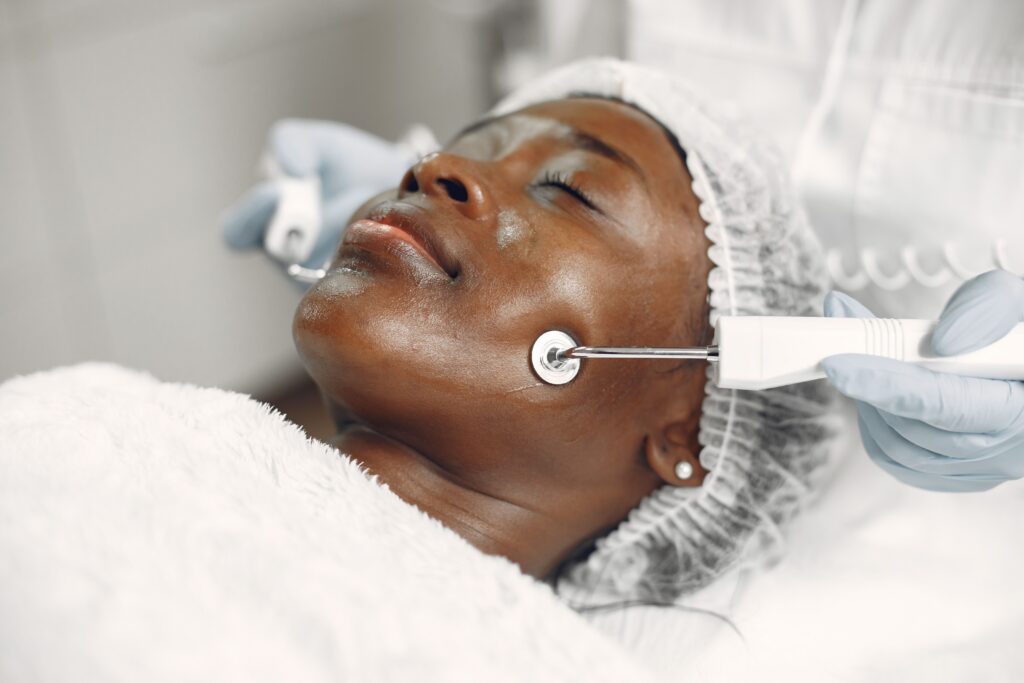
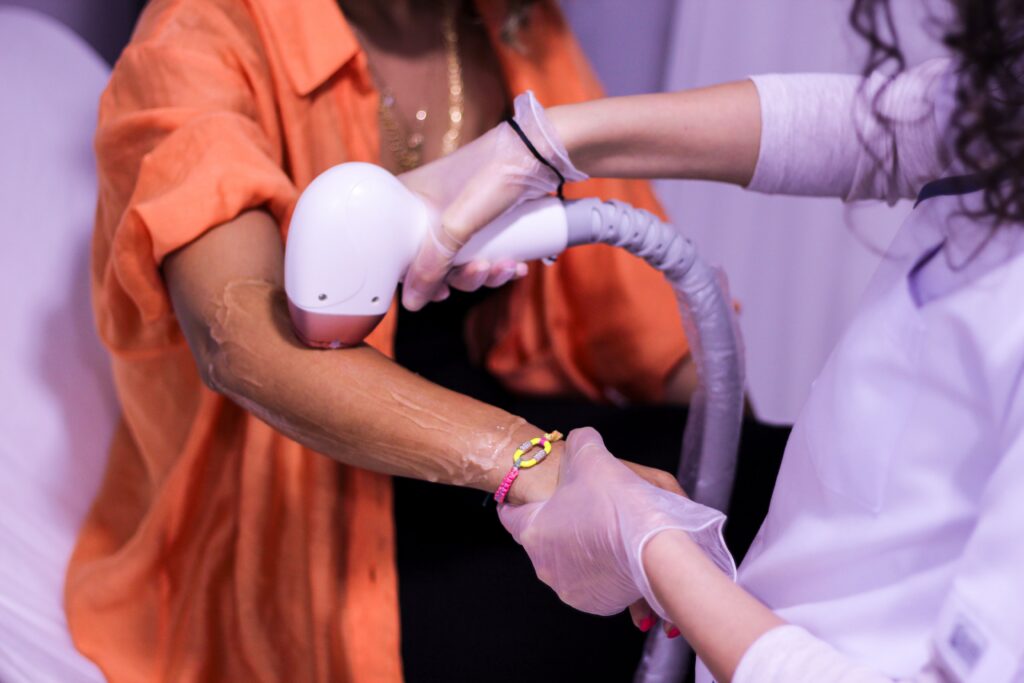
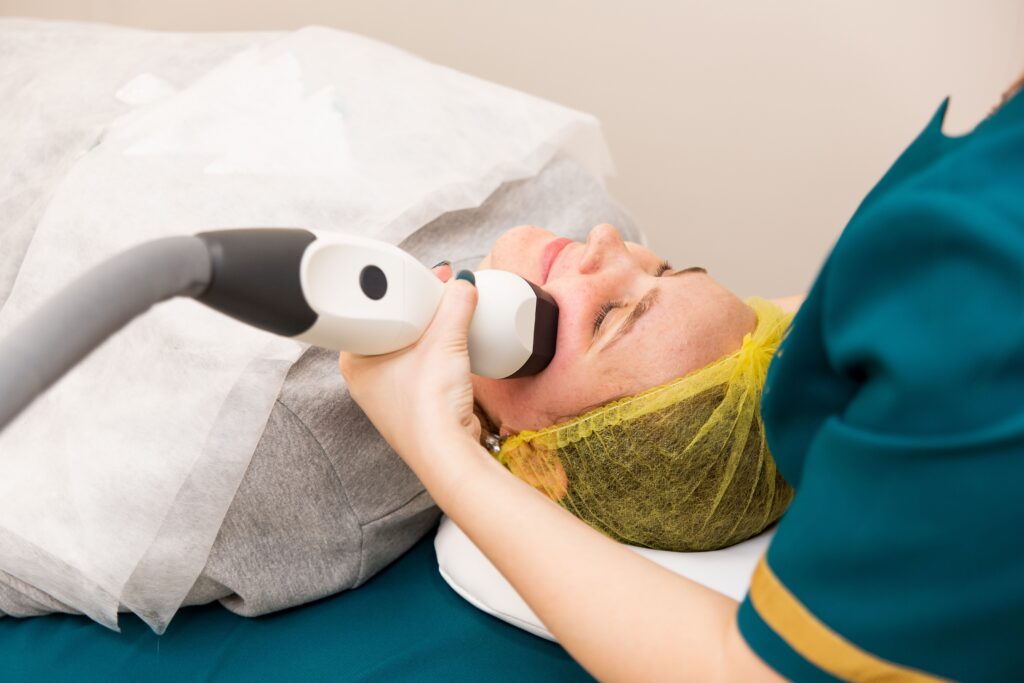
Radiofrequency energy is a form of electromagnetic energy that converts to heat as it meets the natural electrical resistance of skin tissue. A handpiece delivers that energy to the dermis, the skin’s middle layer, where the structural proteins collagen and elastin live alongside the cells that produce them.
Unlike laser treatments, RF energy doesn’t depend on absorption by pigment in the skin, so it isn’t limited by skin tone in the way some light-based treatments are. Providers can also control how deep the energy penetrates and how much heat builds at that depth, which is part of why RF devices can be tuned for different tissue thicknesses and different treatment areas. What makes RF clinically useful isn’t the heat by itself. It’s what that controlled heat does to collagen’s molecular structure, and what it triggers afterward.
Collagen Contraction During the First Phase of RF Treatment
Collagen gets its strength from a triple-helix structure, three protein strands wound together and held in place partly by hydrogen bonds, weak chemical bonds that stabilize the molecule’s shape. When dermal tissue reaches roughly 50 to 65 degrees Celsius, that heat disrupts the hydrogen bonds holding the triple helix together. The collagen fibers denature and physically shrink in response.
This is the reason some patients notice a subtle firming sensation within days of a session. It’s a real, measurable effect, but it’s also a modest one on its own. The contraction affects collagen that already exists in the tissue. It doesn’t add new structural material to the skin, which is where the second phase comes in.
New Collagen Production During the Second Phase of RF Treatment
The body doesn’t experience RF heating as a cosmetic event. It reads the thermal effect as a small injury and responds the same way it responds to any tissue injury: with a wound-healing cascade that moves through inflammatory, proliferative, and remodeling phases.
During that cascade, fibroblasts, the cells in the dermis responsible for manufacturing collagen and elastin, become more active. They increase production of type I and type III collagen and lay down new elastin fibers, gradually rebuilding and reorganizing the dermal matrix around the treated area. This process, the formation of new collagen in response to controlled thermal injury, is called neocollagenesis.
The new collagen produced during this process starts as type III collagen, a more flexible form associated with younger, suppler skin, before gradually maturing into the stronger, more structural type I collagen that makes up most of adult skin’s collagen supply. That maturation is part of why the remodeling process takes months rather than weeks: the body isn’t just producing more collagen; it’s converting and organizing it into a durable structural network.
It’s the same underlying biological mechanism behind other collagen-focused treatments, including Ultherapy’s use of focused ultrasound, just triggered by a different energy source. Readers curious about how collagen behaves as skin ages more broadly, independent of any specific treatment, can find more background on how collagen loss drives visible aging.

RF Skin Tightening and the Collagen Remodeling Timeline
Because collagen remodeling is a biological process, not a switch that flips, it runs on the body’s own repair timeline rather than the treatment’s timeline. Clinical research tracking this process has found a consistent pattern.
During the early weeks, roughly 2 to 6 weeks, patients may begin to notice mild improvement in skin texture and firmness as the wound-healing cascade gets underway. From months 1 through 6, improvement may become more visible as fibroblasts continue producing new collagen and the dermal matrix reorganizes. Studies measuring this process have documented gains in skin tightening that continue to build through the three-month mark and beyond, alongside measurable increases in new collagen at the tissue level.
Beyond 6 months, newly formed collagen continues to mature and organize, which is part of why results can continue to look subtly better well after a treatment series ends.
This timeline is also why RF is typically recommended as a series of sessions spaced weeks apart rather than a single appointment. Each session adds another round of thermal stimulus to a remodeling process that is still working on the results of the last one. Individual results vary based on skin condition, age, sun exposure history, and how the body’s own repair processes respond, and no specific outcome or timeline can be guaranteed.
Candidates for Radiofrequency Skin Tightening
Because RF tightening depends on the dermis responding to a wound-healing signal, candidacy comes down to how much structural work that tissue realistically needs. Clinical literature consistently points to mild to moderate skin laxity as the sweet spot: early sagging, textural looseness, or overall firmness concerns rather than significant, visibly dropped tissue. For more advanced laxity, deeper modalities, or a surgical consultation is generally a more realistic path.
RF devices used for skin tightening are typically FDA-cleared. Most aesthetic devices are cleared rather than approved, and that distinction matters when reading marketing claims. Common, temporary side effects include redness, a warm or tingling sensation, and mild swelling, usually resolving within a few hours to a couple of days.
During a consultation, a provider will screen for contraindications such as implanted electronic devices, including pacemakers or defibrillators, in or near the treatment area; metal implants or other prostheses in the treatment field; and active infection, inflammation, or open lesions in the area to be treated. Pregnancy is also a contraindication, since safety data have not been established.
One clarification worth making is that some RF devices deliver energy through fine needles inserted into the skin, a distinct category called RF microneedling, which reaches deeper tissue through a different delivery method and carries its own safety profile and recovery timeline. This post describes surface-applied RF, the more common starting point for patients exploring skin tightening. Readers weighing the needle-based option can compare the two directly in RF microneedling vs. traditional microneedling.
Whichever approach fits a given patient, a board-certified provider evaluates skin condition, treatment goals, and medical history before recommending RF, a different modality, or a combination, since the biology described here plays out differently depending on the individual tissue it is working with. A thorough evaluation also accounts for factors that can affect how well the remodeling process performs, including skin thickness, existing collagen quality, and sun exposure history, since fibroblasts working in tissue that is already under oxidative strain do not necessarily respond the same way as fibroblasts in less sun-damaged skin.
FAQ
How does radiofrequency skin tightening work?
RF skin tightening uses controlled heat to create two biological responses. Existing collagen fibers contract during the initial phase, while the wound-healing response stimulates new collagen production over the following weeks and months.
How long does it take to see results from RF skin tightening?
Some patients may notice early firmness within several days, but the more visible changes develop over several months as new collagen forms, matures, and reorganizes within the dermis. Results and timelines vary between patients.
What is the difference between surface RF and RF microneedling?
Surface-applied radiofrequency delivers energy through a handpiece placed over the skin. RF microneedling delivers energy through fine needles inserted into the tissue, allowing it to reach deeper layers through a different delivery method. The two approaches have different safety profiles and recovery timelines.
Conclusion
The science behind RF skin tightening explains why the treatment rewards patience: the visible result is downstream of a biological repair process that takes the body months to complete, not something a single session can rush. Readers comparing RF against other non-surgical options can start with the full comparison of RF and ultrasound skin tightening for a broader view of which modality tends to fit which degree of laxity.
Radiofrequency treatment combines immediate collagen contraction with slower collagen and elastin remodeling. The final response depends on the condition of the tissue, the treatment settings, the number of sessions, and how each patient’s repair processes respond. Temporary side effects, treatment suitability, and the appropriate treatment series should be reviewed during a personalized consultation.
Individual results vary, and no timeline or outcome can be guaranteed. Schedule a consultation with Blue Point Medical Spa to talk with a board-certified provider about whether radiofrequency skin tightening fits your skin and your goals.