

The visible signs of aging are not limited to wrinkles. A major part of facial aging comes from volume loss beneath the skin. As the face changes over time, fat pads may shrink or shift, bone structure may gradually change, and the collagen matrix that supports the skin may become thinner. These changes can create hollow cheeks, deeper folds, thinning lips, temple hollowing, and a softer jawline.
Dermal fillers may help restore or support facial volume in selected areas without surgery. By placing a biocompatible filler beneath the skin, a trained provider can support contours, soften selected folds, and improve facial balance. Fillers do not stop aging, replace surgery, or work the same way for every patient, so realistic expectations are important.
At Blue Point Medical Spa in Las Vegas, dermal filler treatments are planned around each patient’s facial anatomy, volume pattern, skin quality, and goals. The provider evaluates which areas have changed, which products may be appropriate, and whether fillers should be combined with other treatments.
How Facial Volume Changes With Age
A youthful face often has more fullness through the cheeks and a smoother transition from the under-eye area to the midface. This shape depends on several structural layers working together. Deep fat pads provide projection, superficial fat pads create smooth contours, facial bones provide support, and collagen and elastin help maintain firmness in the skin.
Over time, each of these layers may change. Bone resorption can reduce support in areas such as the cheekbones, eye sockets, and jawline. Fat pads may shrink, flatten, or descend. Collagen production naturally slows with age, and elastin fibers may lose some of their resilience.
These changes can make the face appear flatter, more hollow, or less defined. The cheeks may lose projection, the temples may look sunken, the lips may become thinner, and the jawline may appear less sharp. In some patients, folds and shadows become more visible because the skin has less structural support beneath it.
In the Las Vegas area, intense UV exposure and desert air may also contribute to visible aging by affecting collagen, hydration, and overall skin quality. While skincare and sunscreen are important, they cannot replace lost facial volume once bigger structural changes have occurred.
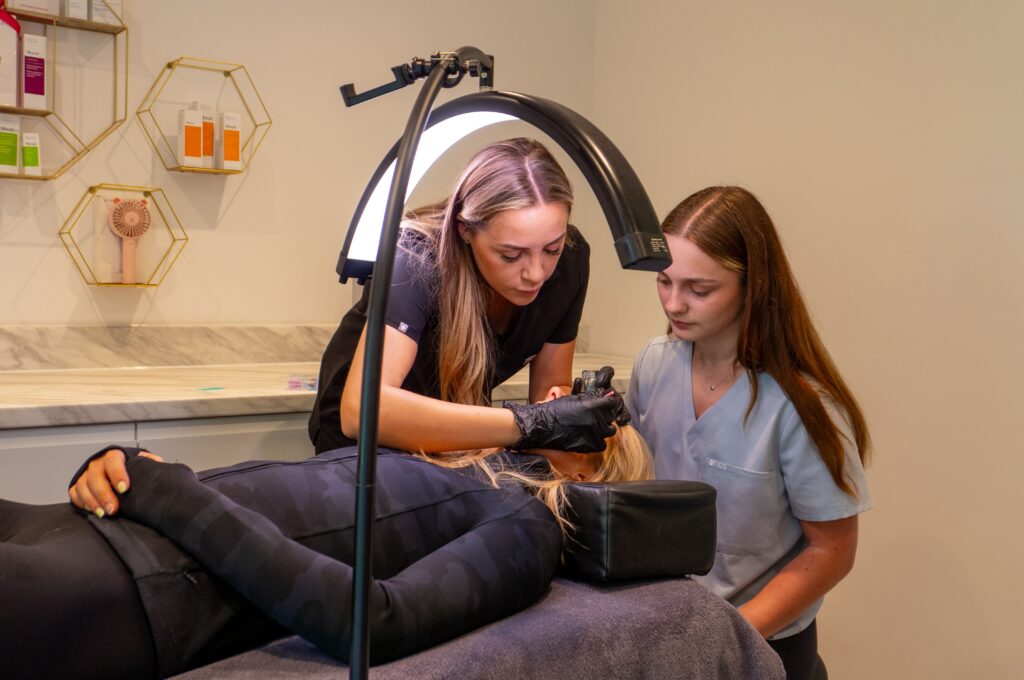
Areas Commonly Affected by Volume Loss
Facial volume loss does not happen evenly across the face. Some areas show change earlier because of their anatomy, skin thickness, and underlying support.
The midface is one of the most common areas affected. As cheek volume decreases, the face may look flatter or more tired. Loss of cheek support may also make nasolabial folds appear deeper, even though the root cause may be higher in the cheek rather than in the fold itself.
The temples can also lose volume. Temple hollowing may create a more drawn or angular look and can affect the frame of the upper face. Because the skin in this area is relatively thin, even moderate volume loss may become visible.
The under-eye area, often called the tear trough, may show hollowness or shadowing as support between the lower eyelid and cheek changes. This area is delicate, and not every patient is a good candidate for filler. Some patients may need treatment in the cheeks first, while others may be better suited for non-filler options.
Lip volume may decrease gradually with age. The vermilion border can become less defined, the body of the lip may thin, and vertical perioral lines may become more noticeable. Fillers may support lip shape or volume in selected patients, but the result should match the patient’s natural facial proportions.
The jawline and chin may also change as bone support shifts and soft tissue descends. This may create a less defined lower face or early jowling. Filler may support contour in some patients, but it cannot correct significant skin laxity or replace surgical lifting.
How Dermal Fillers Support Facial Structure
Dermal fillers are injectable products designed to add or support volume beneath the skin. The goal is not to make the face look overfilled. The goal is to replace or support the structure in areas where volume loss has changed facial balance.
Hyaluronic acid fillers, including products from the Juvederm and Restylane families, are commonly used for volume restoration. Hyaluronic acid, or HA, is a substance naturally found in the body that helps hold moisture. HA fillers vary in thickness and flexibility, which allows providers to choose different products for different areas.
A soft HA filler may be selected for lips or more delicate lines, while a firmer HA filler may be considered for the cheeks, chin, or jawline. HA fillers also have the advantage of being dissolvable with hyaluronidase when appropriate, although this does not eliminate the need for careful placement.
For broader volume depletion, poly-L-lactic acid, commonly known as Sculptra, may be discussed. Sculptra does not work like a traditional immediate volumizer. Instead, it may stimulate the body’s own collagen production over time. Results develop gradually across several weeks or months.
Calcium hydroxylapatite, often associated with Radiesse, may provide more structural support in selected areas. It can offer immediate volume and may also support collagen-related changes over time. Because non-HA fillers are not reversible in the same way as HA fillers, provider experience and conservative planning are especially important.
Patients can learn more about Blue Point’s dermal fillers and the comparison between Sculptra and Voluma before scheduling a consultation.
A Natural-Looking Approach to Volume Restoration
Natural-looking filler results depend on treating the face as a whole. A line, fold, or hollow may not always be the true source of the concern. In many cases, the visible issue is caused by volume loss in a nearby area.
For example, a patient with deep nasolabial folds may assume filler should be placed directly into the folds. Sometimes that is appropriate. In other cases, the folds appear deeper because the cheek has lost support. Restoring the midface may soften the fold more naturally than filling the fold alone.
This structural approach helps avoid an overfilled look. When providers chase every line directly, the face may become heavy or unnatural. When they identify the underlying volume pattern, smaller amounts of filler may create a more balanced result.
At Blue Point Medical Spa, the provider evaluates facial proportions, symmetry, volume distribution, skin quality, and patient preference before recommending product placement. Some patients may need only one area treated. Others may benefit from a staged plan that addresses deeper structural loss first and refines smaller areas later.
Conservative dosing is often recommended, especially for first-time filler patients. Adding less product at the beginning allows swelling to settle and gives the patient time to decide whether more volume is desired. A gradual approach may help maintain a natural appearance.

The Filler Appointment and Recovery Timeline
A dermal filler appointment begins with a consultation. The provider reviews medical history, medications, allergies, prior filler or injectable treatments, and aesthetic goals. The provider also evaluates facial anatomy to decide whether filler is appropriate and which product may fit the treatment area.
Many fillers contain lidocaine, a local anesthetic that may improve comfort during treatment. A topical numbing cream may also be used when appropriate. Patients may feel pressure, pinching, or mild discomfort during injection.
The provider may use a needle or a blunt-tip cannula, depending on the treatment area and clinical judgment. A cannula may be used in some areas to reduce certain risks or help distribute product, while a needle may be preferred for precision in other areas.
Results from HA fillers are often visible immediately, but swelling can make the treated area look fuller at first. The final result usually becomes clearer once swelling settles. This may take several days to two weeks, depending on the area and the patient’s response.
Sculptra results develop gradually as collagen-related support builds over time. This means patients should not expect immediate volume in the same way as HA filler. A series of sessions may be recommended.
Common temporary effects after filler may include swelling, bruising, tenderness, redness, firmness, or mild asymmetry. Patients should follow Blue Point’s pre- and post-treatment care guidelines and contact the provider if symptoms feel unusual or worsen.
Maintaining Filler Results Over Time
The longevity of dermal filler results depends on the product, treatment area, amount used, metabolism, lifestyle, and individual response. Fillers are temporary, although some products may last longer than others.
Lip fillers may need refreshing sooner because the lips move frequently. Cheek fillers or jawline fillers may last longer because those areas have less constant motion. Sculptra may provide longer-lasting collagen-related support for selected patients, but results and timelines vary.
Maintenance should be individualized. Some patients prefer subtle touch-ups before the filler fully fades. Others wait longer between treatments. A provider can help determine whether more product is needed or whether the face should simply be reassessed over time.
Skin care also matters. Fillers support the structure beneath the skin, but they do not replace daily sun protection, hydration, or skin health habits. In the Las Vegas desert climate, daily broad-spectrum sunscreen is especially important.
Professional treatments such as facials, chemical peels, laser treatments, and microneedling may support surface quality, while filler supports deeper structure. A balanced plan may address both volume and skin texture.
Fillers Within a Broader Age-Management Plan
Volume restoration is only one part of facial aging. Some concerns are caused by movement, others by skin quality, and others by laxity. A strong treatment plan identifies which layer is creating the visible concern.
Dynamic wrinkles, such as forehead lines or frown lines, may be better addressed with neuromodulators like Botox. Botox works by temporarily reducing muscle movement. Fillers work differently by supporting volume and contour.
Skin texture, enlarged pores, acne scars, uneven tone, and sun damage may respond better to peels, lasers, microneedling, or medical-grade skincare. Filler will not resurface the skin or treat pigmentation.
Skin laxity may require a different conversation. If the main issue is loose skin rather than volume loss, the provider may discuss Ultherapy or other tightening options. In cases of more advanced laxity, non-surgical treatments may have limitations.
At Blue Point Medical Spa, a provider may recommend a staged plan that combines fillers, Botox, skincare, facials, peels, or laser treatments when appropriate. The goal is not to over-treat. The goal is to choose the right treatment for the right concern.
Safety and Candidacy for Dermal Fillers
Dermal fillers are elective aesthetic treatments, but they still require medical judgment. A qualified provider should review medical history, medications, allergies, prior treatments, pregnancy or breastfeeding status, and any history of autoimmune conditions, bleeding issues, or reactions to injectables.
Not every patient is a good candidate for filler at all times. Treatment may need to be delayed if the patient has an active skin infection, recent dental work, inflammation, certain medical conditions, or unrealistic expectations. A provider should explain when filler is not the right choice.
Potential risks include swelling, bruising, tenderness, lumps, asymmetry, infection, limited response, or dissatisfaction with the result. Rare but serious complications can occur if the filler affects a blood vessel. This is one reason patients should choose licensed providers with training in facial anatomy and complication management.
Patients can learn more about the Blue Point team and Dr. Danka K. Michaels, M.D., before booking. Professional oversight helps support safer evaluation and treatment planning.

FAQ:
What is the difference between volume loss and skin laxity?
Volume loss refers to reduced support from fat, bone, collagen, or deeper facial structure. Skin laxity refers to looseness in the skin itself. Fillers may help support volume, while laxity may require other options such as Ultherapy or a different treatment plan. A consultation helps identify the main concern.
Who is a good candidate for filler-based volume restoration?
Good candidates may have hollow cheeks, sunken temples, thinning lips, under-eye hollows, deepening folds, or reduced jawline definition. The patient should be in good overall health and have realistic expectations. Candidacy depends on anatomy, medical history, skin condition, and provider evaluation.
How many filler syringes are needed for volume restoration?
The number of syringes depends on the area treated and the degree of volume loss. A subtle lip treatment may require less product than cheek, temple, or jawline restoration. Some patients benefit from a staged approach rather than using several syringes at once. The provider recommends the minimum appropriate amount during consultation.
Conclusion
Dermal fillers may help support facial volume, contour, and balance when aging changes the cheeks, temples, lips, under-eyes, or jawline. The best results come from identifying where volume has been lost, choosing the right product, and using conservative placement that respects the patient’s natural features.
At Blue Point Medical Spa, patients receive injectable care guided by consultation, education, and professional oversight. If you are considering filler-based volume restoration, book a filler consultation to discuss which options may align with your anatomy, goals, and comfort level.
Individual results vary. A consultation with a licensed provider is required to determine whether dermal fillers are appropriate. Aesthetic services are elective and may involve risks, side effects, contraindications, bruising, swelling, asymmetry, lumps, vascular complications, infection, limited response, or other outcomes. Recommendations may vary based on anatomy, medical history, medications, prior treatments, product type, treatment area, and personal goals.